Abstract
  BNB
BNB  Base
Base  Sui
Sui  Ton
Ton  Arc
Arc  Enjin
Enjin  Monad
Monad  Arbitrum
  Polygon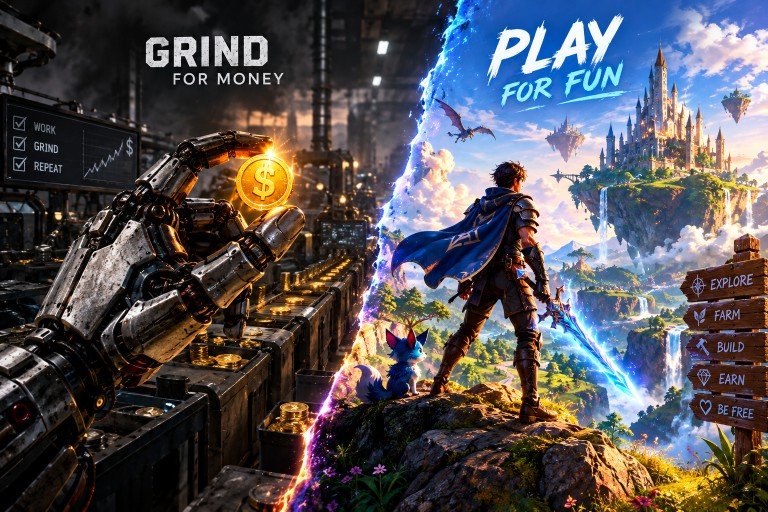
Written by
W3GH Team
Views
1
Published
Sep 29, 2026
Updated
Sep 29, 2026
Tags
#Education
#Guide
#GameFi
If you were around the crypto space in 2021, you couldn't escape the phrase **Play-to-Earn (P2E)**. Games like *[Axie Infinity](/games/axie-infinity)* skyrocketed to multi-billion dollar valuations, promising players the ability to quit their day jobs and earn a living simply by playing video games.
But as the market cooled, a new, more sustainable phrase emerged: **Play-and-Earn (P&E)**.
While they sound almost identical, that one-word difference represents a massive shift in how developers are building Web3 games today. Here is everything you need to know about Play-to-Earn vs. Play-and-Earn, and where the industry is heading.
## What is Play-to-Earn (P2E)?
Play-to-Earn was the first major wave of Web3 gaming. The core philosophy was right in the name: **the primary motivation for playing the game was financial reward.**
### How P2E Works
In a classic P2E model, players usually have to buy an NFT to access the game. By completing daily quests, winning battles, or farming resources, the game rewards them with a native cryptocurrency token. Players then sell this token on an exchange for real money.
### The Problem with P2E
While P2E was incredibly lucrative early on, the economic models proved to be deeply flawed (often relying on hyper-inflation).
1. **It felt like a job:** Players were "grinding" purely for profit. If the token price dropped, players immediately abandoned the game because the gameplay itself wasn't fun enough to keep them around.
2. **Ponzinomics:** For early players to make money cashing out their tokens, new players had to constantly enter the ecosystem to buy those tokens. When new player growth stalled, the token price collapsed.
## What is Play-and-Earn (P&E)?
Recognizing the flaws of P2E, top-tier studios pivoted to a new philosophy: **Play-and-Earn (P&E)**.
In a Play-and-Earn model, the primary focus is **building a genuinely fun, high-quality video game.** The financial rewards are treated as a bonus—a cherry on top of an already great experience—rather than the main objective.
### How P&E Works
* **Gameplay First:** These games compete with traditional AAA and indie games in terms of graphics, lore, and mechanics. You play them because they are fun.
* **Free to Play (F2P) Friendly:** You usually don't need to buy a $500 NFT just to start playing. Anyone can jump in for free.
* **True Asset Ownership:** Instead of farming a highly inflationary token every day, the "earning" comes from owning your digital assets. If you find a rare sword after 100 hours of gameplay, it's an NFT that you actually own. You can trade it, sell it on an open marketplace, or keep it to dominate your friends.
## P2E vs. P&E: A Quick Summary
| Feature | Play-to-Earn (P2E) | Play-and-Earn (P&E) |
| :--- | :--- | :--- |
| **Main Motivation** | Financial Profit | Fun & Entertainment |
| **Gameplay Quality** | Usually secondary/basic | AAA or High-Quality Indie |
| **Barrier to Entry** | High (Requires NFT purchase) | Low (Often Free-to-Play) |
| **Economy Model** | Hyper-inflationary token farming | Asset ownership and peer-to-peer trading |
## The Future of Web3 Gaming
The era of clicking buttons just to print tokens is largely over. The Web3 games launching today—like [EVE Frontier](/games/eve-frontier) and *Illuvium*—are focusing heavily on the **Play-and-Earn** philosophy.
By creating games that players actually want to spend time and money in (just like *Fortnite* or *World of Warcraft*), the economies become sustainable. The blockchain technology simply operates in the background, ensuring you have true ownership over the items you fought so hard to acquire.
Want to discover the next generation of high-quality Web3 games? Browse our [Games Directory](/games) and filter by **Free-to-Play** to start experiencing the Play-and-Earn revolution for yourself!